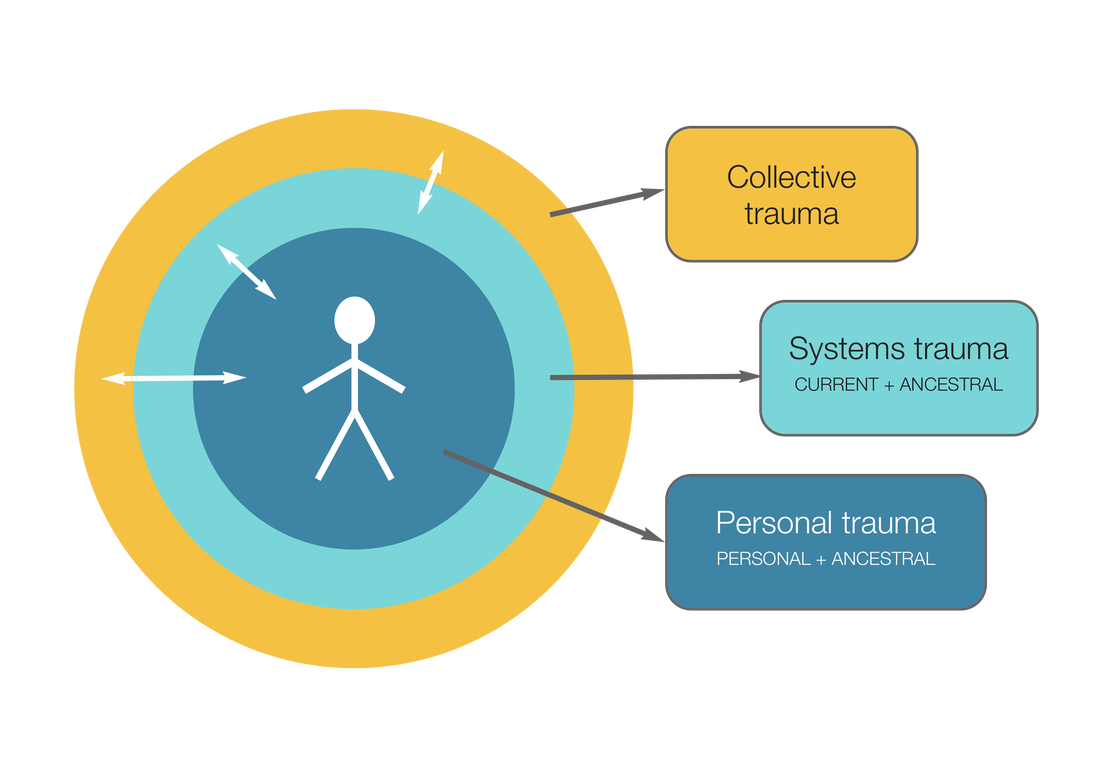
 I have been thinking a lot about this over the last year, stimulated by a programme I did led by Thomas Hübl1 and the Pocket Project2 on Trauma Informed Leadership and supported by working with other coaches in a small reflective enquiry group. A ‘White Paper’ and blogs by Meus.co.uk3 also fed into my exploration of what ‘trauma informed leadership’ is and what it has to do with coaching.
I thought I would set out what my current understanding is, though it is still emerging as I am still learnibng. I currently see Trauma Informed Leadership, as for all trauma informed work, as having three ‘layers’:
It is a big ask for any of us to hold all this in our conscious awareness and probably unrealistic to expect most leaders to. However, if we scale it down a bit, what it means for leaders is:
Ruppert6 has talked about how we live in a traumatising society and unconsciously continue to contribute to that continuing. Hübl’s book7 also looks at collective trauma and how it can be healed. On the programme I did with Hübl and others, many of the questions asked were from those in very traumatising situations wanting solutions. Understandably. However, the responses were to look within oneself first, to do our own work of consciousness raising about our burdened Parts and defensive strategies; we have to start there. I have also been on a few programmes with Roshi Joan Halifax8, in one she talked of moral suffering and identified four elements:
I shared these with an NHS group of coaches I was talking with some weeks ago and the concept of moral distress really resonated with them. They were seeing high levels of burnout, anxiety, and distress within staff and finding clients needed a lot more space to download and process emotions. These are symptoms of a traumatised system where the organisational components are resonating badly with the personal systems, causing these symptoms. Trauma informed leadership needs, I think, moral courage. Maybe we all do to live in a way that we are not contributing to the trauma around us. This from the American Association of Colleges of Nursing9: Moral Courage is the ability to stand up for and practice that which one considers ethical, moral behaviour when faced with a dilemma, even if it means going against countervailing pressure to do otherwise. Those with moral courage resolve ‘to do the right thing’ even if it puts them at personal risk of losing employment, isolation from peers and other negative consequences. Contained within this statement is the core of the issue – the risks that can result from standing up against traumatising policies and practices. Like many, I have coached whistle-blowers and heard how their lives and careers have been destroyed by those who didn’t want to hear the truth. Collective denial can be very punitive. A trauma informed leader would listen differently to such a narrative, would be sensitive to the risk that was being taken, enquire into it with a fully open mind willing to have to face difficult and challenging circumstances. What has this to do with coaching? If we are coaching leaders, it can be a field of reference we hold and if our clients wish to become more trauma informed and that is part of the contract then we can work with them to enhance the qualities needed to lead in that way. We may also need our own moral courage, to speak up to our clients if we experience them talking or acting in ways that deny the trauma in the system or will add to that there. This is where our supervision is always so helpful, to work though in ourselves what is happening for us, and from that position respond in a trauma informed way. While we are working our way through what all this means for us as individuals and coaches we all need to continue to do our own reflective practice and widen our perspectives about the wider field of trauma. 1.https://thomashuebl.com/ 2.https://pocketproject.org/ 3.https://meus.co.uk/blog/2022/03/08/dealing-with-organisational-trauma 4.Dr Richard Schwartz ‘No Bad Parts’. Sounds True; 2021 5.https://meus.co.uk/public/data/chalk/file/e/8/Meus%20Whitepaper%20-%20Organisational%20Trauma.pdf 6.Franz Ruppert. ‘Who am I in a traumatised and traumatising society’. Green Balloon Books;2018 7.Thomas Hübl. ‘Healing Collective Trauma’. Sounds True; 2020 8.https://www.joanhalifax.org/ 9.https://www.aacnnursing.org/5b-tool-kit/themes/moral-courage
1 Comment
Sian Peer
7/6/2023 04:54:10 pm
Can you let me know when you will be planning to run your next training programme Your comment will be posted after it is approved.
Leave a Reply. |